Microchip Petporte Smart Flap®
1. What does this cat flap give us that other cat flaps do not?
2. Does my pet have to be microchipped for the Petporte Smart Flap® to work?
3. How can I tell if my pet's microchip will work with the cat flap?
4. Does it matter where my pet is microchipped?
5. Can the implanting of a microchip harm my pet?
6. Do we have to send you the microchip number?
7. My cat already has a collar - does this matter?
8. Does the original Petporte Smart Flap® work on batteries?
9. What functions work with the Petporte Smart Flap® on battery only mode?
10. What type of battery does the Petporte Smart Flap® require?
11. How do I fit / change the battery in the Petporte Smart Flap®?
12. How long will the battery last?
13. What if I wish to run the Petporte Smart Flap® on low voltage power and my nearest power socket is too far away?
14. What happens if there is a power cut?
15. If there is a power cut, do I have to re-program in all my pets again?
16. Is the Petporte Smart Flap® weather-resistant?
17. Can the Petporte Smart Flap® be fitted into glass doors and double-glazed units?
18. Can the Petporte Smart Flap® be fitted into solid and cavity walls?
19. What do I need to fit the Petporte Smart Flap®?
20. If an intruding cat is also microchipped, will it be allowed access?
21. Can the Petporte Smart Flap® allow some of my pets into my home but keep others out?
22. If I have several cats, how many can I program into the Petporte Smart Flap®?
23. How long after programming in one cat can we program in another cat?
24. How much time does my pet have to enter once the Petporte Smart Flap® has recognised it?
25. Can I control my cats going out through the Petporte Smart Flap® as well as controlling them coming in?
26. If my cat is being chased home by an aggressor, will the aggressor be prevented from entering?
27. Can I adjust the time it takes for the Petporte Smart Flap® to lock after my cat has entered to try and stop aggressors following my cat in?
28. Can I lock the Petporte Smart Flap® to keep my animals inside so that I can take them to the vet?
29. Can I disable the night mode to allow my cats to go in and out freely at any time?
30. Can I adjust the level of light it takes for my Petporte Smart Flap® to lock and unlock when in night mode?
31. Can I hold the flap open with string?
32. What if the Petporte Smart Flap® can't recognise my pet's microchip?
33. Does the Petporte Smart Flap® have to be fitted to an external door?
34. How do I train my cat to use my Petporte Smart Flap®?
1. What does this cat flap give us that other cat flaps do not?
Unlike other cat flaps, the Microchip Petporte Smart Flap® does not require your pet to wear an access device suspended from its collar, for example a magnet or infrared transmitter. The Petporte Smart Flap® recognizes the normal microchip implanted under your pet's skin, thus allowing it entry; therefore it does not require the use of a collar or accessory.
In addition, the Petporte Smart Flap® has the facility of an optional automatic twilight lock-down that prevents pets from going outside once the light level starts to reduce. Statistically, most road traffic accidents and cat fights occur at night so, by using this facility, it will help to prevent your pet being injured.
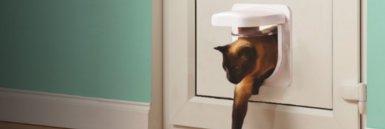
The scanner coil is housed in a unique canopy on the outside of the unit. This enables your cat to be detected and for the flap to be unlocked before your cat reaches it. The canopy also provides some weather proofing for the door and some protection for you cat when exiting from other cats.
Another advantage of moving the scanner away from the door is that it is less likely to be affected by any metal within the materials of the door. There is often a metal security sheet within UPVC doors that could interfere
with the scanning process but this is less likely with the Petporte Smart Flap® because the scanner coil is suspended away from the door. No cover is required on the underside of the canopy to enclose the scanner coil.
Return to the top of the page.
2. Does my pet have to be microchipped for the Petporte Smart Flap® to work?
Yes. Your pet must be microchipped for the Petporte Smart Flap® to be able to recognise each individual animal. The cat flap will not allow any microchipped animal access, only those that have been programmed in.
Return to the top of the page.
3. How can I tell if my pet's microchip will work with the cat flap?
The Petporte Smart Flap® will read most fifteen-digit microchips; these are the microchips that are used in the UK and throughout Europe. It will not read the ten-digit American microchips. To ensure that your pet's number will work, enter the microchip number into our Microchip Compatibility Checker. If you are unsure of your cat's chip number, check with your vet.
Return to the top of the page.
4. Does it matter where my pet is microchipped?
There are international conventions indicating where different species should be microchipped. Dogs and cats should be microchipped in the scruff of their necks. As your pet then attempts to access the Petporte Smart Flap®, its microchip passes under the scanner housed within the porch, allowing the chip to be recognized.
Return to the top of the page.
5. Can the implanting of a microchip harm my pet?
Microchipping has no known harmful effects in dogs. In cats there is a theoretical risk associated with any injection. Statistics show that 1 in 10,000 cats that have an injection is at risk of developing an injection-site tumour. However, this is very rare and is certainly no reason to stop vaccinating or microchipping your cat because, generally, the risks are outweighed by the protection that is provided.
Return to the top of the page.
6. Do we have to send you the microchip number?
No, you do not need to send us your pet's microchip number. You should check that the Petporte Smart Flap® can detect your cat's microchip before fitting it to your door or wall. Simply assemble the Petporte Smart Flap® as instructed and plug it in. Then press the green paw button for ten seconds before passing the scanner over your cat at the distance that your cat will approach the cat flap when fitted. Once detected, your cat will have been programmed in. For each animal that is to use the cat flap, repeat the procedure. It's that simple!
Return to the top of the page.
7. My cat already has a collar - does this matter?
No, for the Petporte Smart Flap® it does not matter if your pet wears a collar or not; it is the under-skin microchip that is recognised and not the collar. Whilst Radio Systems® Corporation advertises that no collar is needed, we do not suggest that pets should not wear a collar. There are many instances where a collar is desirable, for example high-visibility collars, special-diet instruction collars to name but a few. However, we do recommend that any collar worn should be of the breakaway variety in order to prevent injury to your pet.
Return to the top of the page.
8. Does the original Petporte Smart Flap® work on batteries?
Yes, the Petporte Smart Flap® can be powered by either batteries, low voltage power supply or a combination of the two. For operation of all functions and the quickest response to your cat we recommend you use the low voltage power supply because the unit is scanning constantly. This can be backed up with battery power and in the event of a power cut the basic functions of the Petporte Smart Flap® will be retained.
Return to the top of the page.
9. What functions work with the Petporte Smart Flap® on battery only mode?
If you want to power your Petporte Smart Flap® by battery alone the selective entry function will be unaffected but some of the more complex functions will not be possible. In particular night mode will no longer function due to the nature of constantly monitoring light levels. Also, the Petporte Smart Flap® will not be able to function with the forthcoming selective exit and computer control accessories. The response time to your cat will be a little extended because it has to push against the flap to activate the scanner which in turn means the Petporte Smart Flap® cannot run on batteries if fitted to a wall as your pet will have passed the scanner before it pushes the flap to activate it.
Return to the top of the page.
10. What type of battery does the Petporte Smart Flap® require?
The Petporte Smart Flap® requires a PP3 9V battery similar to those found in most home smoke alarms. To get the best continual use out of the battery we recommend the use of a Lithium based battery, as these offer far superior battery life.
Return to the top of the page.
11. How do I fit / change the battery in the Petporte Smart Flap®?
To access the battery compartment use a "slot ended" or straight screw driver to gently lift the battery cover plate with the writing "Pet Porte Smart Flap" above the opening on the indoor section of the unit.
Return to the top of the page.
12. How long will the battery last?
Under normal circumstances and operation the battery should last 6 months but this will vary depending on the traffic through the flap! When the battery power levels are low and the battery needs replacing the green light will illuminate and the red light will flash intermittently.
Return to the top of the page.
13. What if I wish to run the Petporte Smart Flap® on low voltage power and my nearest power socket is too far away?
The Petporte Smart Flap® comes with a 1.8-metre power lead which is often sufficient to reach the nearest power socket. If, however, your power socket is further away, then we do sell 5-metre extension leads which are compatible with the cat flap - see the Accessories section for more information and to purchase extensions.
Return to the top of the page.
14. What happens if there is a power cut?
The basic programmed functions of your Petporte Smart Flap® will continue to operate during a power cut if you have fitted a battery into the unit. The response time to your cat will be slightly extended because the cat has to activate the scanner by pushing on the door.
Return to the top of the page.
15. If there is a power cut, do I have to re-program in all my pets again?
No, once your pets have been programmed in, you will not need to repeat the procedure, even in the event of a power failure.
Return to the top of the page.
16. Is the Petporte Smart Flap® weather-resistant?
The Petporte Smart Flap® has been designed and constructed to resist the adverse effects of weather. To clean your Petporte Smart Flap® simply wipe the unit with a damp cloth, please do not power wash the unit. (Please ensure that you do not use too much water on the damp cloth!)
Return to the top of the page.
17. Can the Petporte Smart Flap® be fitted into glass doors and double-glazed units?
To simplify the fitting of the Petporte Smart Flap® into windows, double or single glazed, it has been designed to fit into a circular cut out of 212 mm diameter. The installation would need to be done by a qualified tradesman who has the equipment to cut holes in glass.
Return to the top of the page.
18. Can the Petporte Smart Flap® be fitted into solid and cavity walls?
Yes, but you must use a "wall model" which has a longer wire between the indoor and outdoor sections, the door versions have about 12 cm of wire, whereas the wall-mounted models have about 38 cm of wire.
We do not provide wall fixing screws because the type needed will vary greatly depending on the wall construction. Various fixing types are available depending on the wall's construction: chemifix bolts and nuts, screws fixed into inter-set or plastic rawl plugs, nylon self drill or polytoggle.
An opening must be formed in the wall at the appropriate height for your cat to be scanned, based on the cutting template provided. The opening should be formed by a qualified builder avoiding utility supplies and not damaging the integrity of buildings damp proof courses.
The principle difference between fitting the Petporte Smart Flap® through a wall and a door is the method of fixing the indoor and outdoor sections to the walls.
To fix the indoor section to the wall utilise the four 5 mm diameter holes in the corners of the interior section that are accessible with the front cover removed.
To fix the outdoor section to the wall utilise the two 6 mm diameter holes in the sides of the exterior frame that support the canopy
The Petporte Smart Flap® comes with a single tunnel section that provides 52 mm length. Extra tunnel extensions can be purchased (see the Accessories section) with each providing 40 mm additional length. These are not provided with wall models because wall thicknesses vary and some people prefer to form their own tunnels using marine grade plywood.
Some people choose to dispense with the canopy and place the scanner coil on top of a tunnel liner by creating an additional space within the wall void to accommodate it.
Return to the top of the page.
19. What do I need to fit the Petporte Smart Flap®?
The Petporte Smart Flap® is designed to be fitted to a door up to 52 mm thick. Larger thicknesses can be accommodated by using extension tunnels or a suitable liner. The hole for the Petporte Smart Flap® needs to be square of 168 mm by 168 mm or a circle of 212 mm diameter. We suggest that the hole should be towards the bottom of the door in order to make it easier for your pet to enter and exit. Ideally, there needs to be an electrical socket within 1.8 metres of the cat flap but, if extension leads are required, then these can be purchased from our Accessories section. The Petporte Smart Flap® should be installed by someone who is competent with a saw (a jigsaw ideally) and, of course, the obligatory screwdriver!
Return to the top of the page.
20. If an intruding cat is also microchipped, will it be allowed access?
No, only your pets that are microchipped and programmed into the Petporte Smart Flap® will be allowed access.
Return to the top of the page.
21. Can the Petporte Smart Flap® allow some of my pets into my home but keep others out?
Yes, simply do not program in the animals that you do not want to enter your home; they will then not be recognized by the Petporte Smart Flap® and, consequently, they will be locked out.
Return to the top of the page.
22. If I have several cats, how many can I program into the Petporte Smart Flap®?
You can program the cat flap with up to thirty one pets.
Return to the top of the page.
23. How long after programming in one cat can we program in another cat?
Once the Petporte Smart Flap® has been programmed with one cat, you can immediately repeat the procedure with another pet.
Return to the top of the page.
24. How much time does my pet have to enter once the Petporte Smart Flap® has recognised it?
Because the Petporte Smart Flap® scans constantly for microchips, your pet will be recognised once it moves beneath the porch. The Petporte Smart Flap® will then unlock the door and keep it open for four seconds after your pet has left the area beneath the porch. After that time the door will be locked again.
Return to the top of the page.
25. Can I control my cats going out through the Petporte Smart Flap® as well as controlling them coming in?
The Petporte Smart Flap® has a "night mode" operation that can keep all your cats in during the hours of darkness. You can select to enable or exit this function and the light intensity at which it is enabled can be adjusted. See the User Guide for more information.
Return to the top of the page.
26. If my cat is being chased home by an aggressor, will the aggressor be prevented from entering?
Yes, provided that the aggressor is four seconds behind your pet.
Return to the top of the page.
27. Can I adjust the time it takes for the Petporte Smart Flap® to lock after my cat has entered to try and stop aggressors following my cat in?
The time that the lock is open once your cat has been detected is set at a default of 4 seconds. However this can be adjusted to suit your cat and its circumstances. The open time can be adjusted from 1 second to 26 seconds. The longer time is ideal for older cats who move slowly and the shorter time is ideal for cats who are being followed in through the flap by an uninvited intruder. What we call "truck and trailer"! See the User Guide for more information.
Return to the top of the page.
28. Can I lock the Petporte Smart Flap® to keep my animals inside so that I can take them to the vet?
Yes, just simply press the red paw button for five seconds and the Petporte Smart Flap® will lock to prevent any animal from going out. We call this "Vet Mode".
Return to the top of the page.
29. Can I disable the night mode to allow my cats to go in and out freely at any time?
Yes, this feature is optional and can be turned on or off by simply pressing the red paw button for one second.
Return to the top of the page.
30. Can I adjust the level of light it takes for my Petporte Smart Flap® to lock and unlock when in night mode?
Yes, this operation needs to be carried out in the morning (sorry if it's in the summer!) when the light is enough that you want your cat to go outside. Please see the User Guide for instructions on how to change the light level.
Return to the top of the page.
31. Can I hold the flap open with string?
Some people hold their flap open with string to allow their cats to move without restriction through the cat flap. If the cat flap is always open then the Petporte Smart Flap® will not be able to offer restricted access to your pets only. However, this is useful to train your cat to use the cat flap.
Return to the top of the page.
32. What if the Petporte Smart Flap® can't recognise my pet's microchip?
This could occur for two reasons: the microchip could have migrated beyond the scanning range of the Petporte Smart Flap® or the microchip could have failed / is of the wrong type (please see Question 3 for checking which types will work). The easiest way in which to check exactly where a microchip is located in your pet, or to check if it is working at all, is to take your pet to your local veterinary surgery where the animal can be scanned with their reader. If the microchip has failed, or is not present, then you can ask your vet to insert a new one. Microchip migration and failure is relatively rare with modern microchips as they are specifically designed to be reliable and are coated with a sticky substance to minimize migration. However, ask your vet for more information on this subject.
Before you fit the Petporte Smart Flap® to your door, we recommend that you test the cat flap out with your cat to ensure that the unit can read your pet's microchip correctly.
When doing this, the easiest method is to hold the Petporte Smart Flap® upside down and move the top of the porch over the cat's back until the unit reads the microchip. When scanning the cat please do NOT hold the porch itself or touch the wires leading from the porch as this will reduce the read-range of the unit to a point where it may no longer read the microchip. Also, when fitting the Petporte Smart Flap® to your door, please note that it is important to position the cat flap as low as possible on the door in order to minimize the distance between the porch and your pet's microchip.
Return to the top of the page.
33. Does the Petporte Smart Flap® have to be fitted to an external door?
No, the Petporte Smart Flap® can easily be fitted to a pet crate or an internal door to control access to the area within. This can be very useful in a multiple-pet household where one or two individual animals are on special or prescription foods. This system has many possible uses, creating special enclaves within a home for certain individual animals, be they nursing mothers or just older pets that need some freedom from young whippersnappers!
Return to the top of the page.
34. How do I train my cat to use my Petporte Smart Flap®?
All selective entry cat flaps have a locking mechanism that is activated or inactivated depending if the cat attempting to enter is authorised or not. This lock action is likely to make a noise that could "scare" some cats so to start with, we recommend that this is inactivated. In the case of the Petporte Smart Flap® there is an audible "beep" that would need to be inactivated as well as the locks.
To inactivate the locks you need to set the Petporte Smart Flap® in "open mode" and then de-activate the beep ("silent mode") as indicated in the User Guide.
Next you need to physically hold the flap open. This is most simply achieved by pushing the flap in, using electrical tape to secure string to it then attaching the string to the door handle. This will keep the flap open and provide the simplest of routes into the house. Unfortunately it will allow every other neighbour-hood cat in to your house but this is no worse than having the flap swing freely. From the cats point of view the action of pushing the flap open may be an issue. This is often the case where a "sensitive" cat has previously attempted to gain access through a flap unsuccessfully. It is difficult to say why but they seem to be keen not to "humiliate" themselves by repeating what was an unsuccessful effort.
Once your cat has been through a few times you can start to lengthen the string so the flap is still open but they have to lift it a little as they walk through it. If this is successful lengthen the string further so they have to lift the flap a little further. This will give your cat the sensation of pressure from the flap resting on their neck, back, and tail as your cat passes through the opening. The Petporte Smart Flap® porch on the outside will help to prevent rain from entering the open aperture!
One your cat is at ease with using the cat flap you can stage the introduction of the locking mechanism by turning off open mode (simply repeat the steps to put the Petporte Smart Flap® in to open mode) and finally the audible beep (again by repeating the process used to de-activate it in the first instance).
Another feature of the Petporte Smart Flap® that encourages cats to use them is their crystal clear transparency. This allows the cats to check the area the other side of the flap before they pass through it. This reassures the cat because it can check to see if there are unfriendly cats the other side of the flap before passing through the door.
Return to the top of the page.